The Essential Marcuse by Herbert Marcuse Andrew Feenberg William Leiss
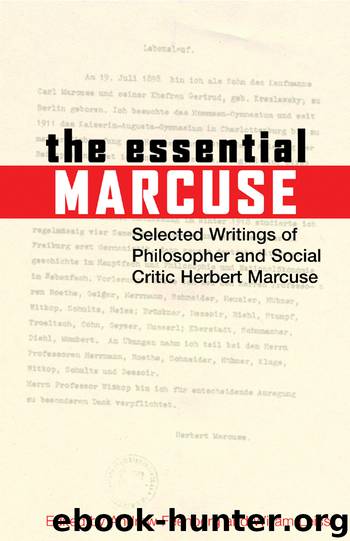
Author:Herbert Marcuse, Andrew Feenberg, William Leiss
Language: eng
Format: epub
Publisher: Beacon Press
Notes
1. Volume 3 of the first section of the Marx-Engels-Gesamtausgabe (MEGA). They appeared almost simultaneously under the title Nationalökonomie und Philosophie in Kröner’s Pocket Editions, Volume 91 (K. Marx, Der Historische Materialismus. Die Frühschriften I) pp. 283ff. This edition does not include the piece printed as the First Manuscript in MEGA, which is essential for an understanding of the whole. The reading of the text is at variance with MEGA in numerous instances.
2. “Reification” denotes the general condition of “human reality” resulting from the loss of the object of labour and the alienation of the worker which has found its “classical” expression in the capitalist world of money and commodities. There is thus a sharp distinction between reification and objectification. Reification is a specific (“estranged,” “untrue”) mode of objectification.
3. p. 165 (my italics).
4. Cf. the passage in Feuerbach which clearly underlies the sentence quoted: “Human feelings thus do not have an empirical, anthropological significance in the sense of the old transcendental philosophy; they have an ontological, metaphysical significance” (Grundsätze der Philosophie der Zukunft, §33; Sämtliche Werke II, 1846, p. 324).
5. Cf. for example: Being-for-itself “comes into its own through labour.” In labour the consciousness of the worker “is externalized and passes into the condition of permanence,” “in working, consciousness, as the form of the thing formed, becomes an object for itself” (Phenomenology of Mind, trans. J. B. Baillie, London, 1966, pp. 238–40).
6. For these connections I must refer the reader to the extensive interpretation of Hegel’s concept of labour in my book, Hegels Ontologie und die Grundlegung einer Theorie der Geschichtlichkeit. Cf. Hegel’s definition of labour in the new edition of the Jenenser Realphilosophie II (Leipzig, 1931, especially pp. 213ff.).
7. Cf. Phenomenology of Mind, p. 220, the concept of “inorganic nature,” and pp. 234ff. of my book Hegels Ontologie, etc.
8. Second impression, B. 33.
9. Feuerbach, Sämtliche Werke II, p. 309.
10. The ontological concept of passion is found similarly in Feuerbach (Werke II, p. 323).
11. e.g. Werke II, pp. 258, 337. The indications of a more profound definition, which doubtless exist in Feuerbach, are not followed through. Cf., for example, the concept of “resistance” II, pp. 321ff.), etc.
12. Cf. the comprehensive formulation in The Holy Family: “that the object as being for man or as the objective being of man is at the same time the existence of man for other men, his human relation to other men, the social relation of man to man” (The Holy Family, Moscow, 1956, p. 60).
13. Feuerbach: “Man is not a particular being like the animal, but a universal being, thus not a limited and unfree but an unlimited and free being, for universality, absence of limitations, and freedom are inseparable. And this freedom does not for example exist in a particular capacity … but extends over his whole being” (Werke, II, p. 342).
14. The German Ideology says of the critique in the Deutsch-Französische Jahrbücher: “Since at that time this was done in philosophical phraseology, the traditionally occurring philosophical expressions such as ‘human essence,’ ‘species’ etc.
Download
This site does not store any files on its server. We only index and link to content provided by other sites. Please contact the content providers to delete copyright contents if any and email us, we'll remove relevant links or contents immediately.
| Anthropology | Archaeology |
| Philosophy | Politics & Government |
| Social Sciences | Sociology |
| Women's Studies |
The remains of the day by Kazuo Ishiguro(9004)
Tools of Titans by Timothy Ferriss(8403)
Giovanni's Room by James Baldwin(7352)
The Black Swan by Nassim Nicholas Taleb(7137)
Inner Engineering: A Yogi's Guide to Joy by Sadhguru(6799)
The Way of Zen by Alan W. Watts(6621)
The Power of Now: A Guide to Spiritual Enlightenment by Eckhart Tolle(5789)
Asking the Right Questions: A Guide to Critical Thinking by M. Neil Browne & Stuart M. Keeley(5779)
The Six Wives Of Henry VIII (WOMEN IN HISTORY) by Fraser Antonia(5519)
Astrophysics for People in a Hurry by Neil DeGrasse Tyson(5196)
Housekeeping by Marilynne Robinson(4455)
12 Rules for Life by Jordan B. Peterson(4310)
Ikigai by Héctor García & Francesc Miralles(4278)
Double Down (Diary of a Wimpy Kid Book 11) by Jeff Kinney(4277)
The Ethical Slut by Janet W. Hardy(4262)
Skin in the Game by Nassim Nicholas Taleb(4256)
The Art of Happiness by The Dalai Lama(4133)
Skin in the Game: Hidden Asymmetries in Daily Life by Nassim Nicholas Taleb(4012)
Walking by Henry David Thoreau(3967)
